File:Sleep and learning timeline with optimization data.jpg: Difference between revisions
Sleep and repetitions timeline displaying repetitions blocks of the current collection (in red) and sleep blocks (in blue) with recomputed circadian approximations on the current data |
No edit summary |
||
| (2 intermediate revisions by the same user not shown) | |||
| Line 1: | Line 1: | ||
Sleep and repetitions timeline displaying repetitions blocks of the current collection (in red) and sleep blocks (in blue) with recomputed circadian approximations on the current data | <blockquote> | ||
'''''Figure:''' Sleep and repetitions timeline displaying repetitions blocks of the current [[Glossary:Collection|collection]] (in <span style="padding: 3px; color: white; background-color: red;">red</span>) and sleep blocks (in <span style="padding: 3px; color: white; background-color: blue;">blue</span>) with recomputed circadian approximations on the current data. <span style="padding: 3px; color: white; background-color: blue;">Blue</span> and <span style="padding: 3px; color: white; background-color: red;">red</span> continuous lines are predictions of optimum sleep time using the SleepChart model (based on sleep statistics). <span style="padding: 3px; background-color: yellow;">Yellow continuous line</span> shows the prediction of the maximum of circadian sleepiness (circadian middle-of-the-night peak) using a phase response curve model. Note that, theoretically, the yellow line should roughly fall into the middle between blue and red lines. However, when a disruption of the sleep pattern is severe, those lines might diverge testifying to the fact that it is very hard to build models that fully match the chaotic behavior of the sleep control system subjected to a major perturbation. <span style="padding: 3px; border: 2px solid red; background-color: cyan;">Aqua dots</span> point to the predicted daytime dip in alertness (i.e. the time when a nap might be most productive).'' | |||
</blockquote> | |||


Latest revision as of 10:17, 3 April 2016
Figure: Sleep and repetitions timeline displaying repetitions blocks of the current collection (in red) and sleep blocks (in blue) with recomputed circadian approximations on the current data. Blue and red continuous lines are predictions of optimum sleep time using the SleepChart model (based on sleep statistics). Yellow continuous line shows the prediction of the maximum of circadian sleepiness (circadian middle-of-the-night peak) using a phase response curve model. Note that, theoretically, the yellow line should roughly fall into the middle between blue and red lines. However, when a disruption of the sleep pattern is severe, those lines might diverge testifying to the fact that it is very hard to build models that fully match the chaotic behavior of the sleep control system subjected to a major perturbation. Aqua dots point to the predicted daytime dip in alertness (i.e. the time when a nap might be most productive).
File history
Click on a date/time to view the file as it appeared at that time.
| Date/Time | Thumbnail | Dimensions | User | Comment | |
|---|---|---|---|---|---|
| current | 10:14, 3 April 2016 | 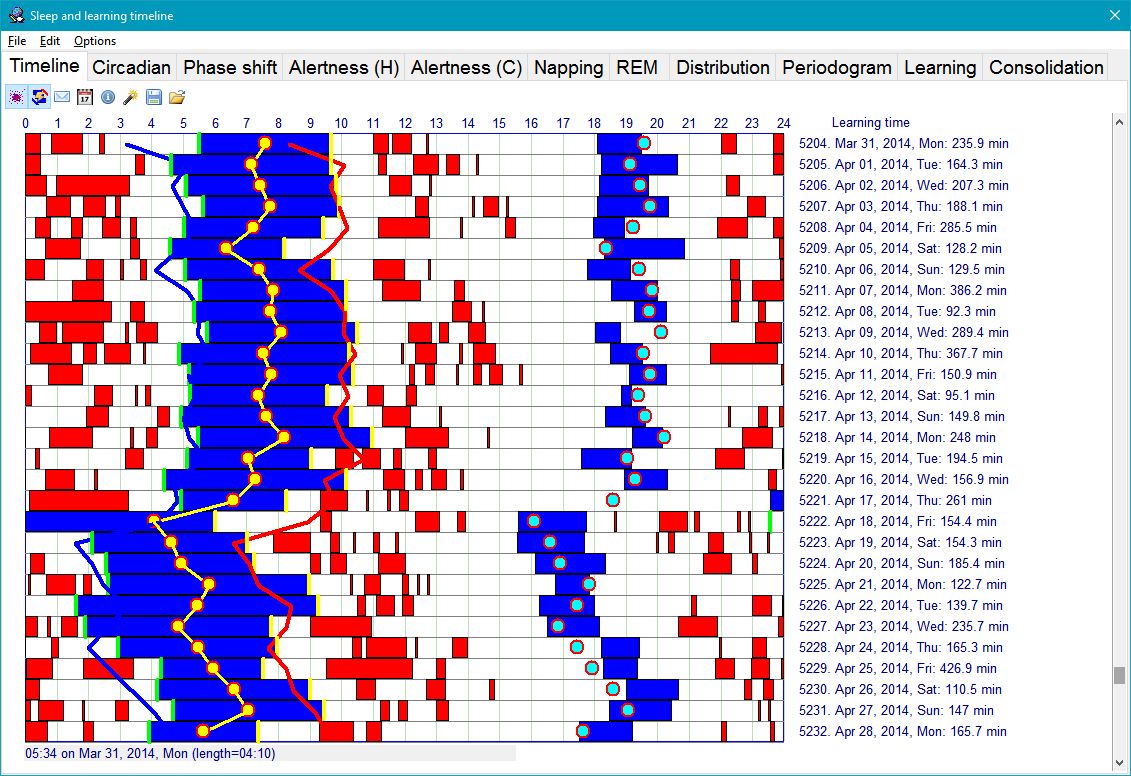 | 1,131 × 776 (233 KB) | SuperMemoHelp (talk | contribs) | |
| 12:15, 22 October 2013 | 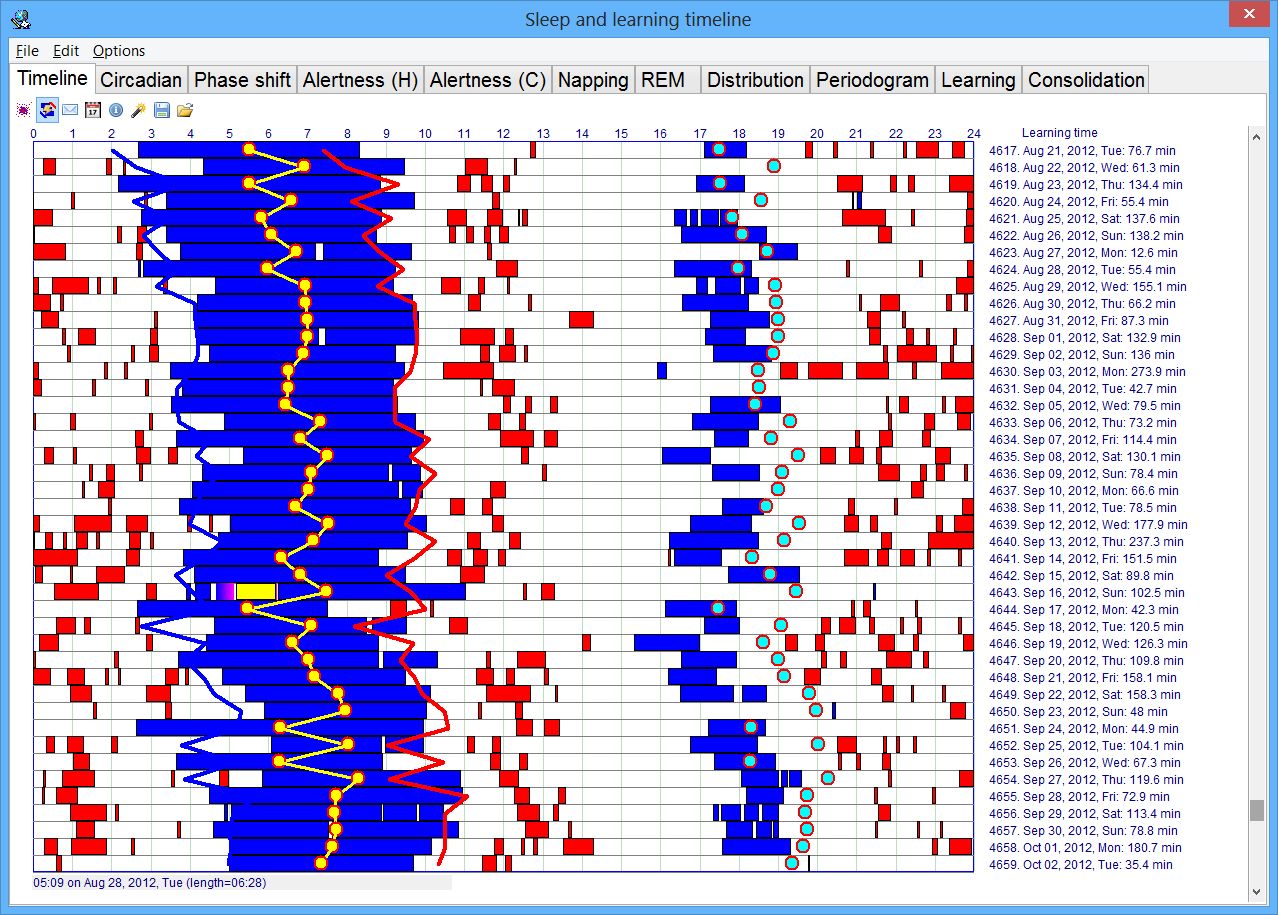 | 1,278 × 915 (323 KB) | SuperMemoHelp (talk | contribs) | ||
| 09:40, 4 May 2009 | 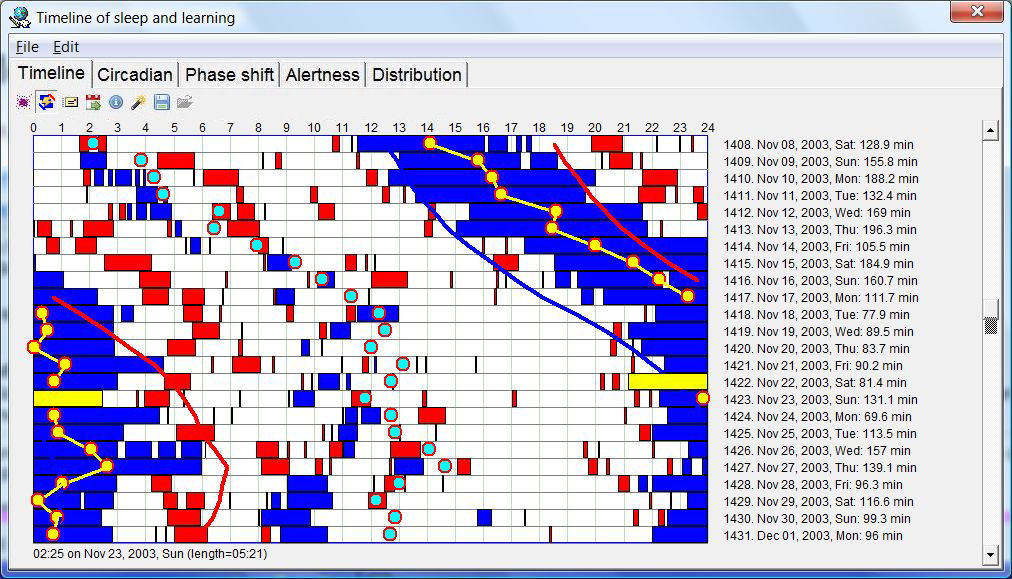 | 1,012 × 579 (169 KB) | WikiSysop (talk | contribs) | Sleep and repetitions timeline displaying repetitions blocks of the current collection (in red) and sleep blocks (in blue) with recomputed circadian approximations on the current data |
You cannot overwrite this file.
File usage
The following 3 pages use this file:
