File:Stability increase function.png: Difference between revisions

mNo edit summary |
No edit summary |
||
| Line 1: | Line 1: | ||
{{Fig|[https://supermemo.guru/wiki/Stability_increase Stability increase] function as computed by [[Algorithm SM- | {{Fig|[https://supermemo.guru/wiki/Stability_increase Stability increase] function as computed by [[Algorithm SM-18]]. The function takes three arguments: (1) [[Glossary:Stability|stability]] at review expressed in days (on the left), (2) [[Glossary:Retrievability|retrievability]] at review (on the right), and (3) memory [https://supermemo.guru/wiki/Complexity complexity] expressed as [[Glossary:Item|item]] [[Glossary:Difficulty|difficulty]] (slider labelled '''Diff''' currently set at 0.8). In the picture, stability increase peaks at around 15 (vertical axis). For some levels of [[Glossary:Stability|stability]] and [[Glossary:Retrievability|retrievability]], the function drops below 1.0 indicating a decrease in [[Glossary:Stability|stability]] (e.g. due to premature review evoking the [[Glossary:Spacing effect|spacing effect]] in massed presentation). 61,768 repetitions of relatively [[Glossary:Difficulty|difficult]] [[Glossary:Item|item]]s were needed to produce this graph (at Diff{{=}}0.8). The longest [[Glossary:Interval|interval]]s reach around 14 years ([[Glossary:Stability|stability]] quantile 5172)}} | ||


Latest revision as of 15:58, 16 March 2019
Figure: Stability increase function as computed by Algorithm SM-18. The function takes three arguments: (1) stability at review expressed in days (on the left), (2) retrievability at review (on the right), and (3) memory complexity expressed as item difficulty (slider labelled Diff currently set at 0.8). In the picture, stability increase peaks at around 15 (vertical axis). For some levels of stability and retrievability, the function drops below 1.0 indicating a decrease in stability (e.g. due to premature review evoking the spacing effect in massed presentation). 61,768 repetitions of relatively difficult items were needed to produce this graph (at Diff=0.8). The longest intervals reach around 14 years (stability quantile 5172)
File history
Click on a date/time to view the file as it appeared at that time.
| Date/Time | Thumbnail | Dimensions | User | Comment | |
|---|---|---|---|---|---|
| current | 13:04, 16 March 2019 | 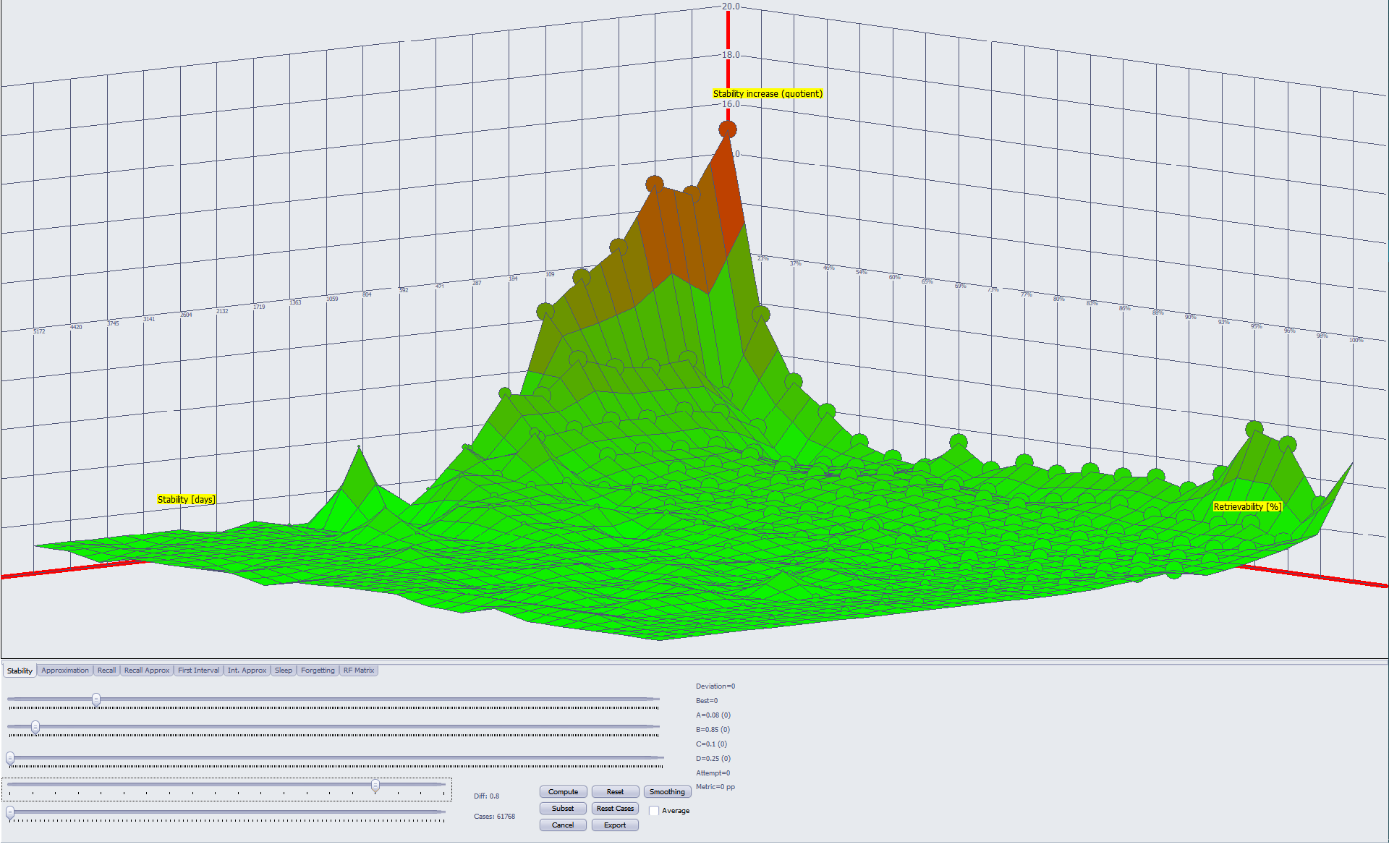 | 1,920 × 1,200 (153 KB) | SuperMemoHelp (talk | contribs) | {{Fig|Stability increase function as computed by Algorithm SM-17. The function takes three arguments: (1) stability at review expressed in days (on the left), (2) retrievability at review (on the right), and (3) memory complexity expre |
You cannot overwrite this file.
File usage
The following 2 pages use this file:
